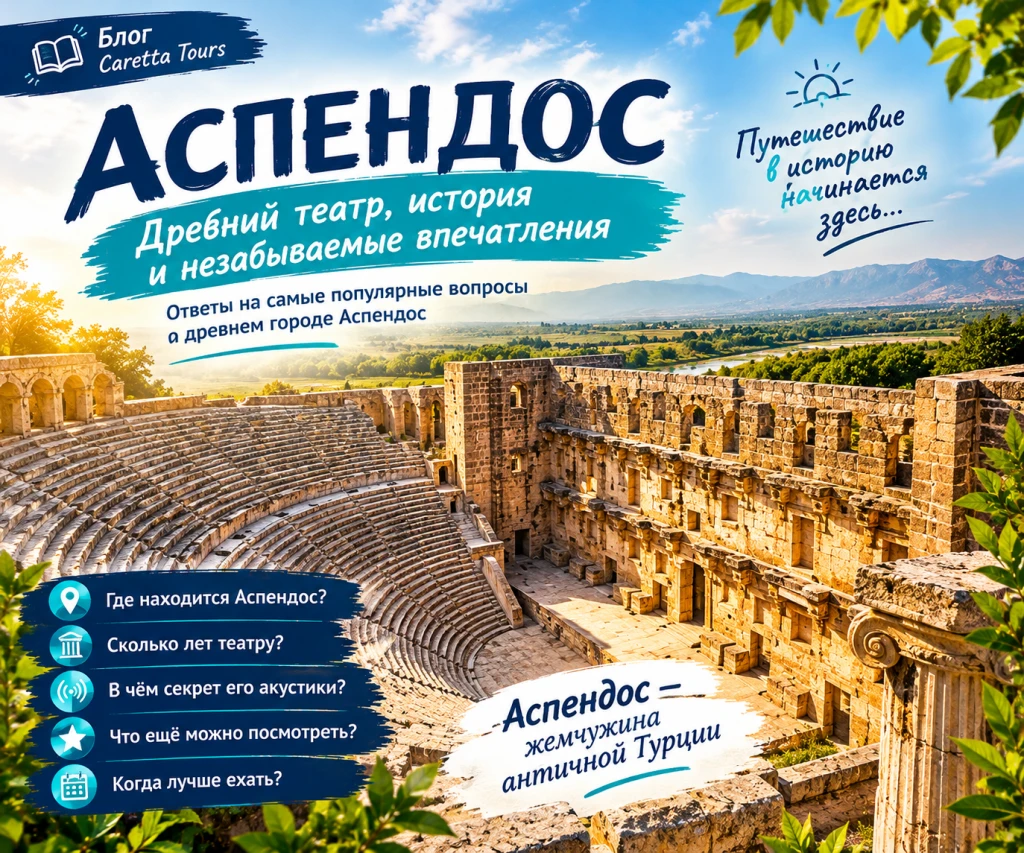
Aspendos in Turkey: History of the Ancient Theatre, Remarkable Acoustics and Secrets of Roman Architecture
Imagine a theatre built almost 1900 years ago, where you can still see the grandeur of Ancient Rome and feel the atmosphere of classical performances.
This is exactly what Aspendos (Aspendos) is — one of the most impressive historical attractions in Turkey.
If you live in Silifke, Erdemli, Tasucu, Kizkalesi or Mersin and enjoy traveling to historical sites, a visit to Aspendos would be an excellent idea for an excursion.
We have prepared answers to the most interesting questions about this remarkable ancient city.
1. Where is Aspendos located in Turkey?
Aspendos is located in the province of Antalya, near the town of Serik, beside the Kopru River, which in antiquity was called the Eurymedon.
From the centre of Antalya to the ancient city is approximately 45–50 kilometres.
Today Aspendos is famous above all for its magnificent Roman theatre, but once there was a flourishing city here with trading squares, temples, public buildings and a complex water supply system.
2. How old is the ancient theatre of Aspendos?
The famous theatre was built in the 2nd century AD, approximately in 160–180, during the reign of the Roman emperor Marcus Aurelius.
Thus, this architectural monument is already about 1850 years old!
The theatre is considered one of the best-preserved Roman theatres in the Mediterranean.
It is especially remarkable that a significant part of its monumental stage building has survived to the present day.
3. Who built the theatre of Aspendos?
The architect of the theatre was Zeno, son of Theodorus, a native of Aspendos.
According to ancient inscriptions, the construction was financed by wealthy benefactors of the city.
Zeno created a structure in which engineering solutions, architecture and the features of the natural terrain were harmoniously combined.
The theatre partly rests against the slope of a hill, and its seating is arranged in a semicircle around the stage.
4. Why has Aspendos been preserved so well?
One of the main mysteries for visitors is why a theatre built almost two thousand years ago has survived so well.
The secret lies not only in the strength of Roman architecture.
In the 13th century, during the Seljuk period, the building was restored and used for new purposes.
Thanks to this, the structure continued to exist and be maintained even many centuries after the end of the ancient era.
Today, traces of Seljuk architectural decoration can be noticed on certain elements of the building.
5. Is it true that the theatre of Aspendos has remarkable acoustics?
Yes! Acoustics is one of the most famous features of the ancient theatre.
The arrangement of the seating rows, the shape of the semicircular space and the architecture of the stage building contribute to the propagation of sound.
A popular story is connected with this, claiming that even quiet sounds from the stage can be heard in the upper rows.
However, such accounts are often exaggerated: audibility depends on the seat, the loudness of the sound and surrounding conditions.
Nevertheless, the acoustic qualities of Aspendos really make it an outstanding monument of ancient engineering.
6. How many spectators could the theatre of Aspendos hold?
Tourist sources often cite a capacity of around 15,000 people, and sometimes more.
However, modern archaeological studies, taking into account the width of the seats and the surviving layout, suggest more cautious estimates — approximately 7,000–8,500 spectators.
The differences are explained by calculation methods and assumptions about how the seating was used in antiquity.
In any case, the theatre was one of the most important public structures of the ancient city.
7. What performances took place in ancient Aspendos?
In the Roman era, the theatre was a centre of public and cultural life.
Theatrical productions, musical performances, solemn events and other public shows could take place here.
For the inhabitants of the ancient city, visiting the theatre was not only entertainment but also an important part of public life.
Today this place helps us imagine the atmosphere of the ancient world.
8. Are concerts and performances held in Aspendos today?
Yes, the historic theatre is known for contemporary cultural events.
Aspendos is associated with the International Opera and Ballet Festival, which attracts lovers of art and historical architecture.
Imagine a musical work performed on the stage of an ancient Roman theatre under the open sky!
However, dates, venues and availability of events change, so the schedule should be checked separately.
9. What else can be seen in the ancient city of Aspendos?
Although most tourists come for the famous theatre, the ancient city offers other interesting historical sites as well.
The aqueducts of Aspendos
The Roman water supply system is considered one of the outstanding engineering structures of antiquity.
Its surviving sections demonstrate how complex technical challenges ancient builders were able to solve.
The ancient agora
The trading and public square was an important part of city life.
Ruins of the basilica and public buildings
They recall the political, commercial and administrative life of ancient Aspendos.
The historic bridge over the Kopru River
Not far from the ancient city stands a bridge associated with the Roman heritage and rebuilt in the Seljuk era.
10. Why was ancient Aspendos a wealthy city?
In antiquity, the city occupied an advantageous position beside the Eurymedon River.
The river provided a connection to the trade routes of the Mediterranean.
The people of the region engaged in agriculture, trade, wine and olive oil production and other crafts.
Salt and horses, for which ancient Aspendos was famous, played a special role in the economy.
Thanks to trade, the city was able to finance the construction of magnificent public structures.
11. Is Aspendos on the UNESCO list?
The theatre and aqueducts of ancient Aspendos have been included in the UNESCO World Heritage Tentative List since 2015.
This means the site is considered a candidate for possible inclusion in the main World Heritage List.
Its architectural value is linked to the exceptional preservation of the theatre and the engineering achievements of ancient builders.
12. Can Aspendos be visited with children?
Yes, a visit to the ancient theatre can be an interesting family trip.
Children especially enjoy looking at the huge stone tiers and imagining how thousands of spectators gathered here many centuries ago.
However, one should take into account the high steps, uneven stone surfaces and hot weather in summer.
It is recommended to choose comfortable footwear and bring drinking water.
13. When is the best time to go to Aspendos?
Spring and autumn are especially comfortable for historical excursions.
In these months it is usually easier to walk among the ancient structures and explore the archaeological sites.
In summer it is better to plan the visit for the morning hours and take the high air temperature into account.
It is advisable to check opening hours and entrance ticket prices before your trip.
14. Can Aspendos be combined with Side and Manavgat?
Yes! This is one of the interesting options for a cultural journey along the Mediterranean coast of Turkey.
Depending on the programme, you can combine:
- Aspendos — the famous ancient theatre.
- Side — an ancient city with classical monuments and beautiful sea views.
- Manavgat — natural attractions and a waterfall.
Such a route allows you to combine history, architecture and relaxation in nature.
15. Are there excursions to Aspendos from Silifke, Erdemli and Mersin?
If you live in Silifke, Tasucu, Atakent, Susanoglu, Kizkalesi, Erdemli or Mersin, you can consider organized trips to the historical attractions of Antalya.
Caretta Tours offers excursion trips around Turkey, including routes combining historical cities and natural attractions.
Current trip dates, pick-up options along the route, the guide's language and prices should be clarified when booking.
Why you should see Aspendos at least once
Aspendos is not just ancient stone walls.
It is an opportunity to see outstanding achievements of Roman architecture, to touch the history of the Mediterranean and to imagine the life of people almost two thousand years ago.
Here every stone recalls the craftsmanship of ancient builders, and the majestic stage continues to amaze travellers from around the world.
Discover historical Turkey with Caretta Tours!
If you live in Silifke, Erdemli, Tasucu or Mersin, follow our excursion programmes and choose new destinations for your travels.
CARETTA VOYAGE TURİZM
📞 +90 537 644 48 97
📞 +90 536 489 65 33
Caretta Tours — journeys that reveal history!
Aspendos in Turkey: history, theatre and excursions | Caretta Tours
Where is Aspendos, what is the ancient theatre famous for and how to visit it? History, acoustics, tips for tourists and excursions from Silifke and Mersin.
Aspendos Turkey
ancient theatre Aspendos
Aspendos history
Side Manavgat Aspendos tours from Tasucu, excursions from Silifke, tours from Mersin, excursions in Turkey, Cappadocia from Mersin, weekend tours in Turkey, excursions from Kizkalesi, excursions from Erdemli, Gaziantep tour, thermal holiday in Mersin, Russian-speaking excursions in Turkey
Excursions and tours around Turkey from Tasucu, Silifke and Mersin. Cappadocia, Mardin, Gaziantep, Antalya, thermal hotels. November–December 2026.
